Native BTC Swaps Without Wrapping
Wrapped Bitcoin is a claim on BTC sitting somewhere else. A native swap moves real Bitcoin and hands you the real asset on the other side. Here is the difference, and how RAVN does it.
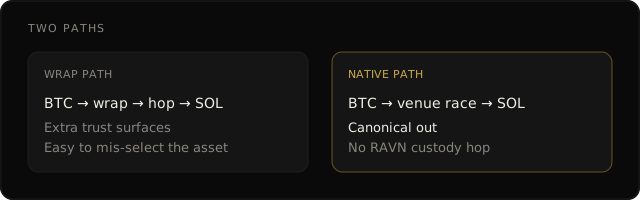
Quick answer
A native BTC swap moves real Bitcoin on the Bitcoin network. You do not mint a wrapped token first. What lands on the other side is the real asset you picked: ETH, SOL, or USDC on the chain you chose. On RAVN, up to five venues race for every native Bitcoin swap, and we pick the one that leaves you with the most after costs.
Wrapped BTC is not Bitcoin
"BTC on Ethereum" usually means wBTC, cbBTC, or another IOU. Those tokens are useful in DeFi. But they depend on someone holding the real coins behind them.
| Native BTC | Wrapped BTC (e.g. wBTC, cbBTC) | |
|---|---|---|
| Chain | Bitcoin | Usually EVM or another smart contract chain |
| What you hold | Bitcoin UTXOs | A token that claims 1:1 backing |
| Typical use | Settlement, self-custody, exits | DeFi, EVM liquidity, collateral |
| Who you trust | Bitcoin itself and your keys | Whoever mints and backs the wrap |
Neither is wrong. Mixing them up is. If you want ETH, SOL, or USDC, wrapping first is an extra hop you did not ask for. If you want real Bitcoin out, a wrap on another chain is not the finish line.
How people usually leave Bitcoin
- A centralized exchange. It works, but they hold your coins in the middle, and KYC is normal.
- Wrap, then swap. Fine when you need the wrap. Wasteful when you just wanted ETH or SOL.
- Bridge aggregators. Many route through wraps, and native Bitcoin is often missing.
- A native swap. Sell real BTC for the real asset you want, in one quote. This is what RAVN does.
We never hold your funds, write no settlement contracts, and never hand you a wrapped token by default.
What lands in your wallet
- InReal BTC on Bitcoin, when Bitcoin is the source.
- OutETH as ether, SOL as Solana's own coin, USDC on the chain you picked, and real BTC when Bitcoin is the destination.
- NotA receipt token we made up, or a wrapped token you did not choose.
If you pick wBTC or cbBTC as the destination on purpose, that is a different trade, and you get what you picked.
How a native BTC swap works
- You ask for a quote on a pair with Bitcoin on one side, like BTC to SOL, SOL to BTC, BTC to ETH, or BTC to USDC.
- We ask five venues at once: Relay, NEAR Intents, THORChain, Chainflip and Rift. Each covers different pairs and sizes. A venue that does not support your pair sits that race out.
- We rank them on what you actually receive after costs. When two are close, the faster one wins.
- When Bitcoin is the source, the winner gives you a DEPOSIT: send BTC to one address. From other chains, you usually sign a TRANSACTION. The quote tells you which.
- Status goes from pending to processing to success, or to refunded if the swap cannot complete.
Expect minutes, not seconds. Bitcoin needs block confirmations, and no venue can skip them. We never hold the BTC. Settlement runs on the venues themselves.
Building on the API
Send destinationAddress with the quote request, plus refundAddress when Bitcoin is the source. Skip them and several venues return a price preview with executable: false. Then branch on one field, executionType. For a BTC deposit, the MCP tool ravn_btc_prepare_send builds the unsigned PSBT for you to sign.
When wrapping still makes sense
- You need BTC inside an EVM protocol that only lists wBTC or cbBTC.
- You lend, borrow, or provide liquidity with that exact wrap.
Use a wrap when the wrap is what you want. Do not end up with one by accident.
What it costs
- Swapping in the app: 0 bps from RAVN, permanently. You still pay the venue's spread and network fees.
- Integrators: you set your own fee, from 0 to 100 bps. It shows in the quote.
- Gas: we add no markup. You pay normal Bitcoin network fees to send. Gasless only applies to certain EVM routes, not to Bitcoin.
Read next
- NEAR Intents on RAVNOne of the five BTC venues.
- Relay on RAVNOne of the five BTC venues.
- Garden Finance on RAVNA past BTC venue. Registered, not racing today.
- Best execution is not the best headline rateWhy we rank on what you receive.
- How to swap BTC to SOLBitcoin into Solana.
- How to swap SOL to BTCSolana back to real Bitcoin.
- How to swap BTC to ETH without wrappingBitcoin to ether, not wBTC.
- BTC and USDC both waysStablecoins in and out of Bitcoin.
- How RAVN worksThe race and the execution types.
- Security and settlementWhy we never hold your funds.
Race it yourself
No key, no account. Ask the quote endpoint for a pair and see which venue wins right now. RAVN never holds your funds.
FAQ
What is a native BTC swap?
A swap with real Bitcoin on the Bitcoin network on one side. You get the real asset on the other side, and nothing forces you through wBTC or cbBTC on the way.
Is wBTC the same as Bitcoin?
No. wBTC is a token on Ethereum, backed by someone holding the real coins. It is useful in DeFi, but it is not Bitcoin in your own wallet.
Does RAVN ever give me wrapped BTC?
Only if you pick a wrapped token as the destination. Pick BTC and you get real Bitcoin.
Which venues handle native BTC on RAVN?
Five: Relay, NEAR Intents, THORChain, Chainflip and Rift. They race for each swap, and the one that gives you the most after costs wins.
Is this the same as a bridge?
No. A classic bridge locks your coins and mints a copy that you keep. RAVN routes through venues that deliver the real asset, and we run no bridge of our own. One venue, NEAR Intents, uses its own bridge for the minutes a swap takes, and you still end with the real asset.