Best Execution Is Not the Best Headline Rate
The biggest number on a quote screen is not always what you keep. RAVN ranks every route on what you receive after gas, and picks the faster one when it is close.
Quick answer
The biggest number on a quote screen is the headline rate. It is not always what ends up in your wallet. What counts is what you keep after gas.
RAVN asks every venue that can do your swap at once. We rank them on net output: what you receive after gas. When two are close, the faster one wins. So a venue can post the biggest number and still lose.
A bigger number that loses
Two quotes, same pair, same amount:
| Quote A | Quote B | |
|---|---|---|
| Headline output | Higher | A bit lower |
| Swap gas you pay | Real money on this chain | None. A solver pays it (gasless RFQ) |
| Price | Can move before it fills | Firm when you sign |
| What you keep | Headline minus gas, and approval if needed | Close to the headline |
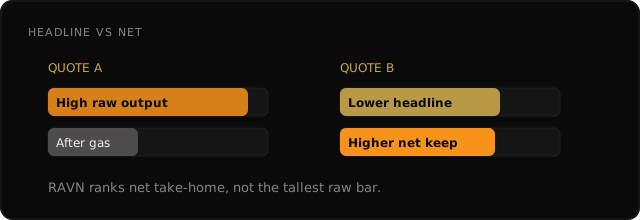
If A beats B by less than A's own gas bill, B leaves you with more. A sort by raw output picks A. We pick B.
What we rank on
- NetWhat you receive after estimated gas, plus approval when you need one.
- FloorYour slippage limit is a hard line. Quotes that break it never reach your screen.
- GaslessGets the edge only while it stays close on price. A gasless quote that pays much less still loses.
- SpeedWhen two routes pay about the same, the faster one wins.
- CanonicalYou get the real asset on the chain you picked, not a wrapped stand-in.
How one quote works
- You ask for a pair, an amount and the chains.
- We pick the venues that can do that route. Native BTC races Relay, NEAR Intents, THORChain, Chainflip and Rift. Solana can include Jupiter Ultra. One EVM chain can include 0x Gasless, Bebop and CoW.
- We ask them all at once. If one fails, the others still answer.
- Every answer gets the same shape: output, fees and how you settle.
- We rank them. The winner is the quote you see, or the
quoteTokenan integrator passes to execute.
You pick the outcome. The router picks the venue.
How we count gas
We estimate the gas each quote costs you, plus approval when needed, and convert it into the token you are buying. Then we compare output minus cost.
- A gasless quote carries no swap gas. A rival that needs gas pays it in the comparison. A raw output sort misses that.
- If we cannot cost a quote honestly, we do not guess zero. That would favor the quotes whose costs we could not see, so ranking falls back instead.
We will not crown a route that loses to its own fees.
Gasless has to stay close
On-chain prices can move between quote and fill. RFQ market makers on one EVM chain (0x Gasless, Bebop, CoW) give you a firm price instead. You sign off-chain, and a solver pays the gas.
That still is not a free win. We compare the firm quote to the rival's guaranteed floor: the least that rival delivers after its own slippage. If the firm quote trails that floor by too much, the on-chain route wins.
Three ways to settle
- TXTRANSACTION: sign and send the transaction we return. Across, Relay, Mayan, Jupiter Ultra and others.
- SIGSIGNATURE: sign a message, and RAVN submits it. 0x Gasless, Bebop and CoW.
- DEPDEPOSIT: send your coins to an address the venue gives you. NEAR Intents, and swaps that start from native BTC.
The ranking comes first. The type only tells you what to sign or send.
What it does not promise
- Not the mid-market price. Depth, inventory and venue coverage set the real range.
- Not gasless everywhere. Only RFQ routes that settle by signature skip swap gas. Deposit and on-chain routes pay network fees. We add no gas markup.
- Not zero slippage everywhere. Firm RFQ quotes do not slip. Other routes can.
- Not custody. RAVN never holds your funds. Settlement stays on the venue.
Using it as a trader or builder
- Traders: Look at what you receive, not just the big number. Re-quote if the market moved or the quote expired.
- Integrators: Call
POST /quote, pass thequoteTokento execute, and branch onexecutionType. Thealternativesfield shows the routes that lost, with their output and time. Do not re-sort by raw output, or you undo the ranking. - Both: Native BTC and wrapped BTC are different products. Our native BTC guide explains why.
Race it yourself
No key, no account. Ask the quote endpoint for a pair and see which venue wins right now. RAVN never holds your funds.
FAQ
What is best execution in a crypto swap?
It means picking the route that leaves you with the most after costs. Not the one with the biggest number before gas, slippage and fill quality.
Why can a lower headline rate be better?
Because gas comes out of your pocket. If the bigger quote costs more in gas than it gains, or is much slower for about the same result, the smaller one leaves you better off.
Does gasless always win on RAVN?
No. A gasless route wins only while it stays close to the rival's guaranteed floor, the least that rival delivers after its own slippage. If it trails too far, it loses.
Is zero slippage guaranteed on every RAVN swap?
No. Firm RFQ routes such as 0x Gasless, Bebop and CoW do not slip. On-chain and deposit routes can, and they pay normal network fees.
How do I see what RAVN picked?
The app shows the winning route. Integrators get the winner plus alternatives, the routes that lost, with their output and time. GET /health shows which venues are live.